


Automate Repetitive Tasks. Unlock Smarter Business Decisions.
Dayma Infotech helps businesses explore AI-powered automation solutions designed to simplify repetitive tasks, improve access to business insights and support faster responses to routine requests. By combining robotic process automation (RPA), intelligent analytics and AI-powered support tools, organisations can identify opportunities to streamline workflows and make better use of their data.
From automating rule-based digital tasks to analysing business information and assisting employees or customers, AI-powered automation can help connect people, processes and technology more efficiently.
Bring Intelligence and Automation into Everyday Work
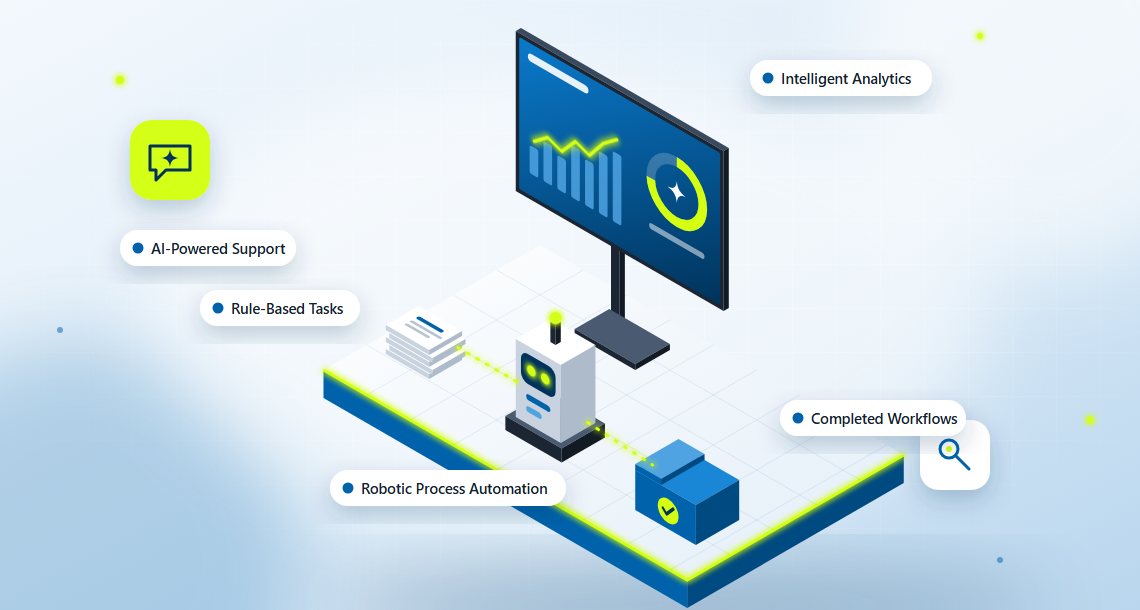
AI-powered automation combines software automation, data analysis and AI capabilities to support business processes. RPA can handle structured, repetitive digital tasks, analytics tools can identify patterns in business data, and AI assistants can help users find information or respond to common queries.
The right solution depends on the workflow, available data, existing software, security requirements and the level of human oversight needed.
Our AI-Powered Automation Capabilities
Dayma Infotech can help businesses explore AI and automation technologies for administrative, operational, customer-support and data-driven workflows.
- Robotic Process Automation (RPA): Automate repetitive, rule-based tasks such as data entry, document handling, information transfer and routine system updates where compatible.
- Intelligent Analytics: Use analytics and AI-enabled tools to summarise data, identify patterns, highlight anomalies and support business reporting.
- AI-Powered Support: Explore AI assistants and chatbots that help answer common questions, guide users through processes and retrieve approved information.
- Document Processing: Investigate tools that extract, classify and summarise information from invoices, forms, reports and other business documents.
- Workflow Automation: Connect compatible applications to coordinate tasks, approvals, notifications and routine follow-ups.
- AI-Assisted Reporting: Generate summaries and management insights from available business data, subject to data quality and system capabilities.
- Human-in-the-Loop Workflows: Route sensitive, unusual or high-impact cases to employees for review, approval or decision-making.
“AI-powered automation combines the speed of software with the ability to analyse information, helping people focus on decisions, service and higher-value work.”
Less Repetition. More Intelligence.
AI Powered Automation
Connect AI Capabilities with Real Business Requirements
Successful automation starts by identifying a clear business problem rather than introducing AI for its own sake. Some workflows are best handled through conventional rule-based automation, while others benefit from AI-assisted document understanding, natural-language interaction or analysis of complex data.
Dayma Infotech can help businesses explore opportunities such as:
- Automating repetitive data entry and application-to-application tasks.
- Extracting information from business documents for further processing.
- Generating summaries and reports from approved data sources.
- Supporting employees with internal knowledge assistants.
- Handling routine customer or employee enquiries through AI-enabled support tools.
- Identifying unusual patterns or trends in operational information.
- Connecting automation workflows with existing business applications.
Each project should define its expected outcome, source data, software compatibility, access permissions, human review requirements and success measures before implementation.
Important: AI outputs can be inaccurate, and automated workflows can propagate errors if not properly designed. Sensitive data, financial transactions, external communications and other high-impact actions should have suitable access controls, testing, monitoring and human approval where required.
Frequently Asked Questions About AI-Powered Automation
AI-powered automation combines software workflows with AI capabilities to assist with tasks such as document processing, data analysis, information retrieval and customer or employee support.
RPA generally automates structured, rule-based tasks by interacting with software systems. AI can interpret text, recognise patterns, summarise information or handle less structured inputs. The two can be combined in one workflow.
Often, yes. Integration may be possible through APIs, connectors, supported file exchanges or desktop automation. Feasibility depends on the software, access permissions and technical limitations.
Analytics can help teams summarise performance, identify trends, compare results and investigate unusual patterns. The quality of the insights depends on data quality, context and the methods used.
AI assistants can handle selected routine queries and help users find information, but complex, sensitive or exceptional cases often require human judgement and escalation.
Start with one well-defined, repetitive or information-heavy process. Map the current workflow, establish measurable success criteria, assess data and security requirements, then test a limited implementation before expanding.
AI-Powered Automation Solutions
Explore RPA, intelligent analytics, AI-powered support and workflow automation opportunities for your business.
