


Track Every Part. Connect Every Process. Build Greater Visibility.
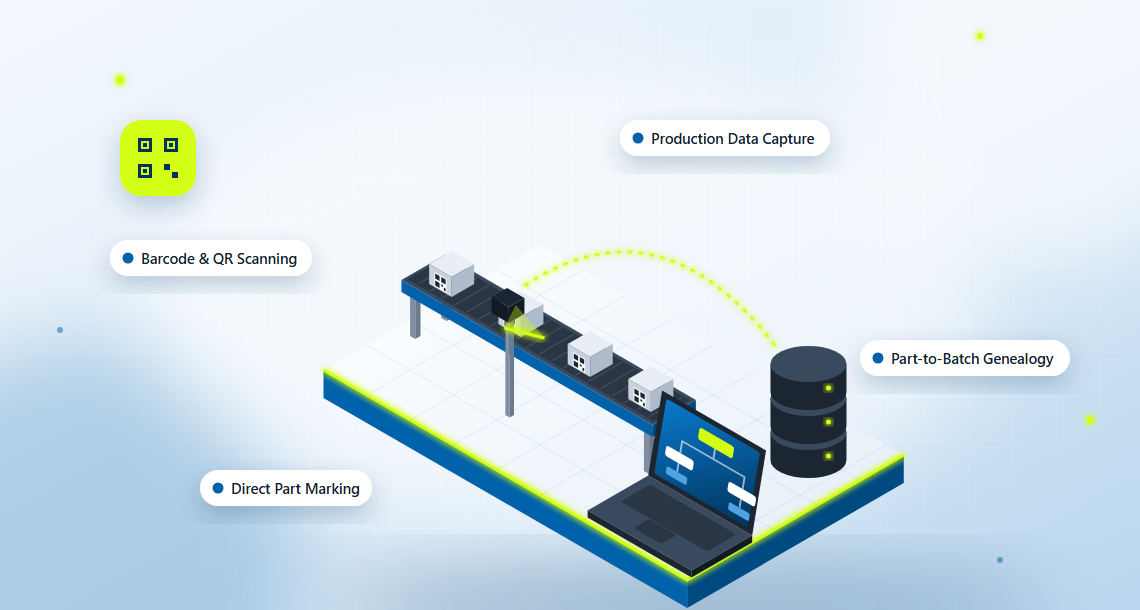
Dayma Infotech helps businesses explore industrial traceability solutions designed to track components, products and batches throughout manufacturing and production workflows. By combining barcode and QR code scanning, direct-part-mark reading, production data capture and database connectivity, traceability systems can create a clearer record of where parts originate, how they move through production and which processes they pass through.
From individual component identification to part-to-batch genealogy, these solutions can help businesses improve production visibility, support quality investigations and maintain more consistent records.
Connect Product Identity with Production History
Traceability links a product or component to the information recorded during its journey through production. Each scan or system event can capture relevant details such as a part identifier, batch number, process stage, timestamp or inspection result.
When connected to suitable production controls and database systems, this information can help teams retrieve product histories, investigate quality issues and identify affected batches more efficiently.
Our Traceability Capabilities
Dayma Infotech can help businesses explore traceability technologies for manufacturing lines, assembly operations, packaging processes and industrial production environments.
- Barcode and QR Code Reading: Capture product, component and batch identifiers using compatible scanners or camera-based reading systems.
- Direct-Part-Mark (DPM) Reading: Explore reading solutions for codes marked directly onto components using methods such as laser marking, dot peening or other marking processes.
- Part-to-Batch Genealogy: Link individual parts to their batches, parent assemblies, production orders or other relevant manufacturing records.
- PLC-to-Database Data Capture: Capture selected production events and machine data from compatible PLCs and transfer them to connected databases or software platforms.
- Production Event Logging: Record key events such as part arrival, processing, inspection, rejection and completion, depending on system configuration.
- Traceability Record Retrieval: Support searches using identifiers such as serial numbers, batch codes, production orders or timestamps.
- Quality and Recall Investigation Support: Help identify relevant production histories and potentially affected batches when a quality issue occurs.
“Reliable traceability connects each product to its production history, helping businesses make better-informed quality and operational decisions.”
Every Part Has a Story
Traceability
Build a Connected and Searchable Production History
An effective traceability system needs more than a barcode scanner. It requires a consistent identification strategy, reliable data capture, clear relationships between parts and batches, and appropriate storage and retrieval processes.
Dayma Infotech can help businesses explore solutions for:
- Identifying products, components and batches at defined production stages.
- Linking part identifiers with work orders, batch numbers and assembly records.
- Connecting scanning devices and compatible PLCs with databases or business applications.
- Recording inspection outcomes and production status changes.
- Retrieving product history for quality checks and troubleshooting.
- Supporting traceability across connected production stations.
- Planning data capture for new production lines or upgrades to existing operations.
The final design should consider data accuracy, network reliability, access permissions, record-retention requirements and integration with existing manufacturing or enterprise systems.
Frequently Asked Questions About Traceability
Industrial traceability is the ability to identify a product or component and retrieve relevant information about its origin, batch, production steps, inspections and movement through a manufacturing process.
Barcodes typically encode information in a one-dimensional pattern, while QR codes use a two-dimensional pattern. Direct-part marking places a code directly on a component's surface. The best method depends on the product, marking conditions, environment and scanning requirements.
Part-to-batch genealogy records relationships between individual components, batches, assemblies and production orders. It helps teams understand which components went into a product and which products may be associated with a particular batch.
Yes. With compatible interfaces and suitable integration, production events and selected PLC data can be captured and stored in databases or connected software platforms.
Traceability records can help teams retrieve production histories, review inspection outcomes and identify potentially affected parts or batches. Its effectiveness depends on the completeness and accuracy of recorded data.
Often, yes. Existing lines may be upgraded with scanners, identification devices, data-capture interfaces and database connectivity. A technical assessment is needed to determine compatibility and integration requirements.
Industrial Traceability Solutions
Explore barcode and QR scanning, direct-part-mark reading, production data capture and part-to-batch tracking options.
