


Automate Repetitive Handling with Precision and Consistency
Dayma Infotech helps businesses explore robotic pick-and-place solutions designed to automate repetitive material-handling tasks across manufacturing, assembly, packaging and production environments. From robotic loading and part transfer to packing operations and vision-guided picking, these systems can help streamline workflows and support consistent handling across production shifts.
By coordinating robotic arms, suitable grippers, machine vision, conveyors and PLC-based controls, businesses can explore automation options aligned with their product types, production volumes and operational requirements.
Move Parts, Products and Materials with Greater Consistency
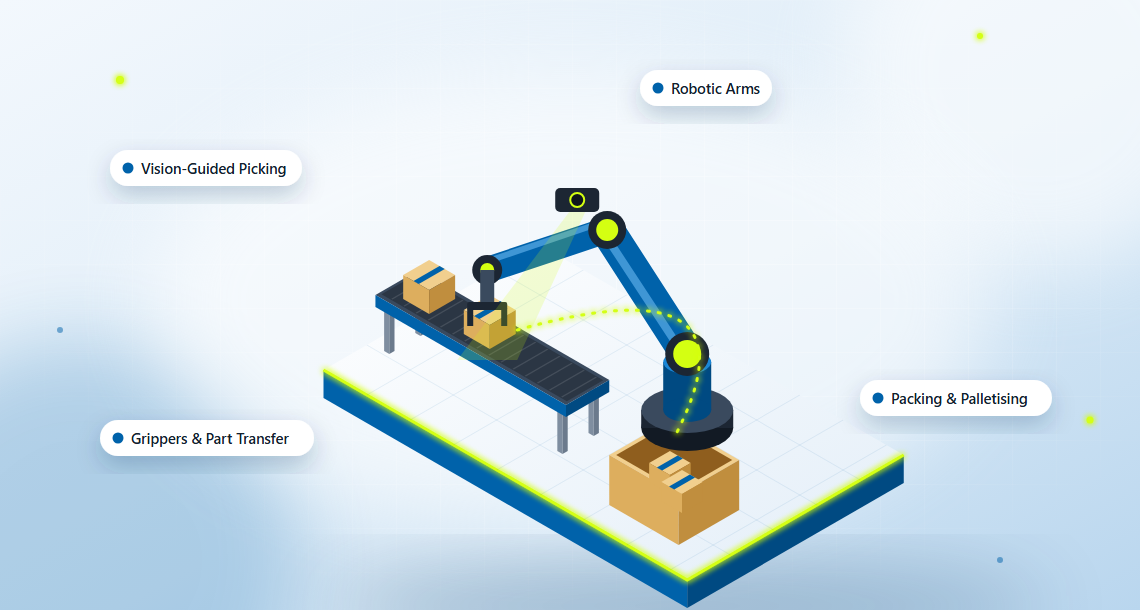
Robotic pick-and-place systems use programmed movements and suitable end-of-arm tooling to pick up an item and place it at a designated location. Depending on the application, the robot may handle individual components, transfer parts between machines, load workstations or arrange products for packaging.
When combined with vision systems and production-line controls, robotic handling can also accommodate variations in product position and coordinate movements with connected equipment.
Our Robotic Pick-and-Place Capabilities
Dayma Infotech can help businesses explore robotic handling technologies for production lines, assembly operations, packaging workflows and machine-tending applications.
- Robotic Loading and Unloading: Explore robotic cells for loading or unloading compatible machines, fixtures, trays and workstations.
- Part Transfer and Handling: Automate the movement of components between production stages, conveyors or designated work areas.
- Pick-and-Place Robot Cells: Plan robotic work cells around product dimensions, payload, reach, cycle time and workstation layout.
- Vision-Guided Picking: Use compatible cameras and vision software to identify item locations and guide robotic picking where the application supports it.
- Robotic Packing and Sorting: Explore automated placement, product grouping and handling for selected packaging and sorting workflows.
- Grippers and End-of-Arm Tooling: Select suitable gripping tools, suction devices or other end effectors according to product shape, weight and handling requirements.
- Conveyor and PLC Integration: Coordinate robot movements with compatible conveyors, sensors, PLCs and upstream or downstream machinery.
“Robotic pick-and-place automation helps businesses move repetitive handling tasks into a coordinated process built around consistency, accuracy and operational efficiency.”
Consistent Handling. Smarter Production.
Robotic Pick-and-Place
Design Automation Around Your Production Workflow
Successful robotic handling depends on choosing the right robot, gripper, sensing system and control architecture for the task. Product variation, required cycle time, payload, reach, placement accuracy and available floor space all influence the final design.
Dayma Infotech can help businesses explore options for:
- Automating repetitive pick-up and placement tasks.
- Transferring components between machines or conveyor sections.
- Loading and unloading compatible production equipment.
- Using vision systems to locate randomly positioned or variable items.
- Integrating robotic cells with PLCs, sensors and conveyor controls.
- Planning robotic handling for packing, sorting and assembly operations.
- Assessing opportunities to expand or adapt automation as production requirements change.
Before implementation, each application should be evaluated for cycle-time requirements, product handling, robot reach, tooling, machine interfaces and operator access.
Safety note: Robotic cells must be designed with appropriate risk assessment, guarding, interlocks and safety-related controls. Collaborative robots also require application-specific safety assessment; their collaborative designation alone does not make every application safe.
Frequently Asked Questions About Robotic Pick-and-Place
It uses an industrial robot or suitable robotic system to pick up an item from one location and place it at another according to a programmed sequence or control logic.
Common applications include machine loading, component transfer, assembly support, sorting, product placement and selected packing operations.
Vision-guided picking combines cameras and image-processing software with robot controls to identify item locations and guide picking movements. Its suitability depends on lighting, product variation, camera performance and application requirements.
Yes, where the robot, sensors, conveyor controls and PLC interfaces are compatible. Integration may require synchronisation, product detection, interlocks and coordination with upstream and downstream equipment.
Important factors include payload, reach, cycle time, placement accuracy, product characteristics, end-of-arm tooling, operating environment and available workspace.
Many systems can be configured for multiple products by changing robot programs, grippers or vision recipes. The amount of changeover required depends on product variation and the system design.
Robotic Pick-and-Place Solutions
Explore robotic handling, vision-guided picking, machine loading, packing and conveyor integration options.
