


Improve Product Quality with Intelligent Vision Inspection
Dayma Infotech helps businesses explore machine vision and automated inspection solutions designed to support quality control, product verification and production-line consistency. From presence and orientation checks to dimension measurement, label verification and print inspection, vision systems use cameras, lighting and image-processing software to evaluate products against defined criteria.
By integrating vision inspection with suitable production equipment and control systems, businesses can explore ways to identify defects earlier and make quality checks more consistent.
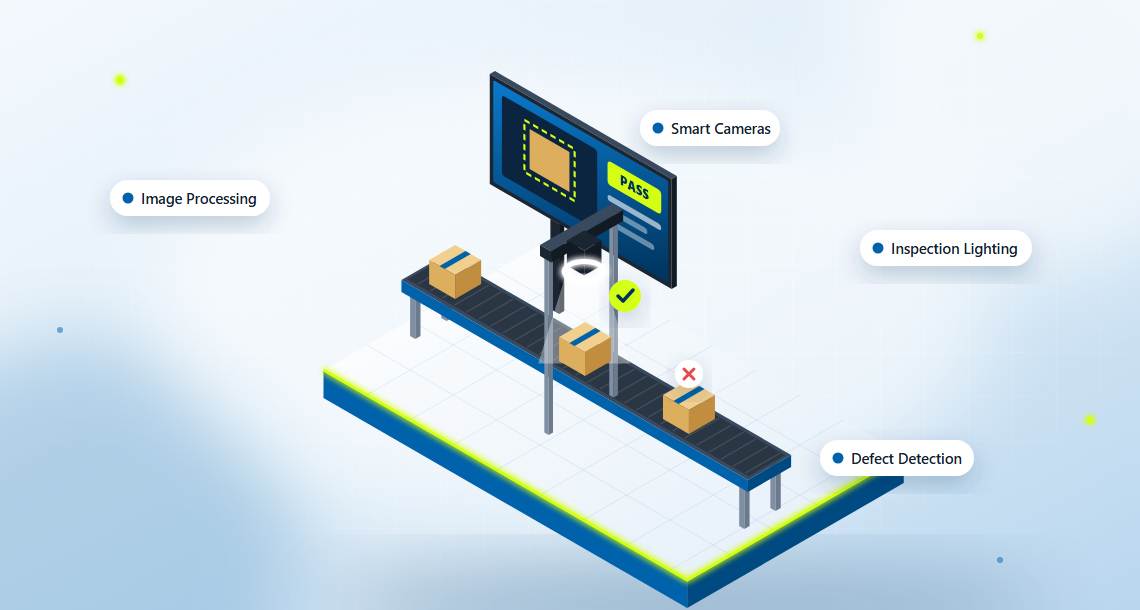
Turn Product Images into Actionable Quality Checks
Machine vision systems capture images of products and analyse them using configured rules or image-processing algorithms. Depending on the application, they can check whether components are present, verify product orientation, measure dimensions, read labels and identify printing inconsistencies.
When integrated with compatible line controls, inspection results can also trigger alerts, product tracking or automatic rejection of items that do not meet defined acceptance criteria.
Our Vision Inspection Capabilities
Dayma Infotech can help businesses explore vision inspection technologies for manufacturing, packaging, assembly and other automated production environments.
- Presence and Absence Checks: Verify that required components, parts, caps, seals or other product elements are present.
- Orientation and Position Verification: Check whether a product or component is correctly positioned or aligned before the next production step.
- Dimension Measurement: Use camera-based measurement to inspect selected dimensions against configured tolerances, subject to system capability and calibration.
- Label Verification: Check label presence, placement and selected label characteristics.
- Print and Code Verification: Inspect printed text, markings and supported barcodes or other codes for readability or conformity with defined requirements.
- Automatic Reject Integration: Connect inspection results to compatible reject mechanisms or line controls so that failed products can be diverted or removed.
- Image Capture and Logging: Store inspection images and associated results where supported, helping teams review defects and investigate quality issues.
“Automated vision inspection turns images into quality decisions, helping production teams identify issues and respond with greater consistency.”
See More. Check Consistently. Improve Quality.
Vision Inspection
Integrate Inspection into Your Production Workflow
Effective vision inspection depends on more than a camera. Product presentation, lighting, camera resolution, inspection speed, software configuration and the required level of accuracy all influence system performance.
Dayma Infotech can help businesses explore options for:
- Inspection of products moving along conveyor lines.
- Verification of components during assembly.
- Label placement and packaging checks.
- Dimensional inspection for selected product features.
- Detection of visible defects under defined inspection conditions.
- Integration with PLCs, conveyor controls and compatible reject stations.
- Image-based quality records and inspection reporting.
Each application should be evaluated using representative product samples and defined acceptance criteria before selecting the final system. Inspection accuracy, cycle time and defect-detection performance depend on the product, environment and system configuration.
Frequently Asked Questions About Vision Inspection
Machine vision inspection uses cameras, lighting and image-processing software to capture and analyse product images for quality checks, identification, measurement and verification.
Depending on its configuration, it can check component presence, orientation, dimensions, label placement, printing, supported codes and selected visible defects.
Yes. Suitable vision systems can be synchronised with conveyor movement and connected to compatible PLCs or line controls to perform inspections at defined production stages.
Yes, when the vision system is integrated with compatible control equipment and a suitable reject mechanism. The system must be configured and validated for the specific application.
Many systems support image capture, inspection-result logging and reporting. Storage capacity, retention, search functionality and integration depend on the selected hardware and software.
Selection depends on product size, defect type, required accuracy, conveyor speed, lighting conditions, inspection environment and integration requirements. Testing with representative samples is recommended.
Vision Inspection Solutions
Explore camera-based inspection, product verification, dimensional checks and automated quality-control options.
