


Make Production Issues Visible. Enable Faster Response.
Dayma Infotech helps businesses explore Andon and visual signalling solutions designed to communicate machine status, production interruptions and operator assistance requests across industrial environments. From signal towers and operator call stations to fault-based escalation, downtime tracking and reporting, these systems help teams make production issues visible and direct them to the appropriate personnel.
Whether used on a standalone machine or across a production line, Andon systems can support clearer communication between operators, supervisors, maintenance teams and production managers.
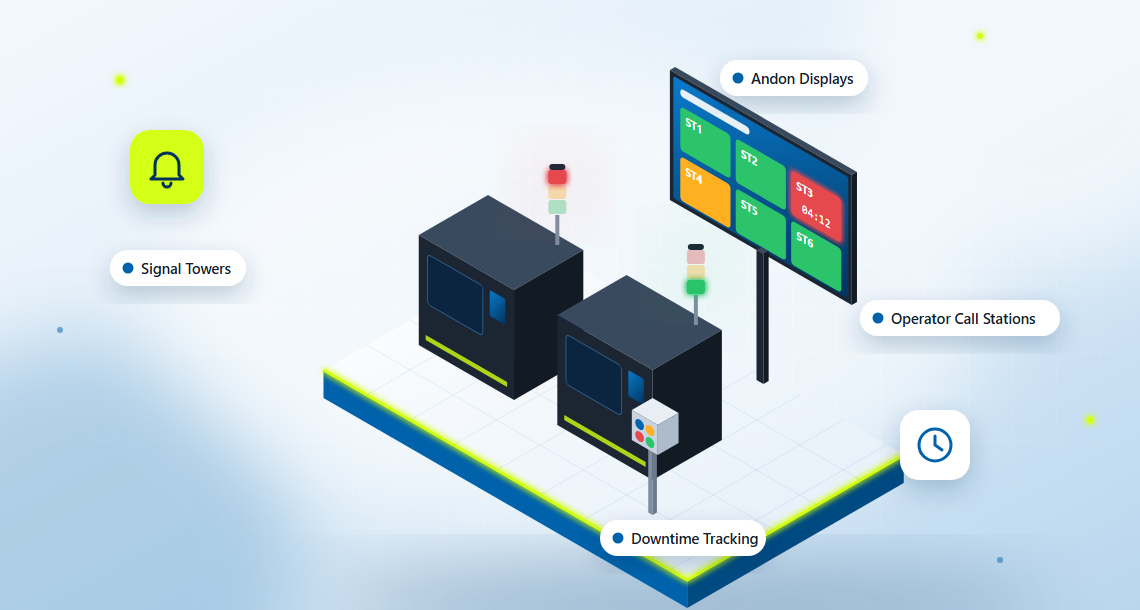
Turn Machine Status into Clear, Actionable Signals
Andon systems use visual indicators, audible alerts, operator call stations and connected displays to communicate the current status of equipment or production processes. Different signals can represent normal operation, a warning, a machine fault, a material shortage or a request for assistance.
When connected to suitable controls and monitoring software, these signals can also generate event records, trigger notifications and provide information about recurring stoppages.
Our Andon & Visual Signalling Capabilities
Dayma Infotech can help businesses explore visual signalling and production-alert technologies for manufacturing plants, assembly lines and automated workstations.
- Signal Towers and Stack Lights: Use colour-coded visual indicators to communicate machine status, warnings, faults and assistance requests.
- Operator Call Stations: Provide accessible buttons or interfaces for operators to request support from supervisors, maintenance teams or material-handling personnel.
- Audible and Visual Alerts: Combine lights, buzzers or other supported indicators to make important events noticeable in noisy or busy production environments.
- Fault-Based Escalation: Route alerts according to fault type, machine condition or designated response responsibilities.
- Time-Based Escalation: Configure alerts to escalate when an issue remains unresolved beyond a defined time threshold.
- Downtime Counting and Reporting: Record stoppage events, durations and fault categories where supported by the connected system.
- Production-Line Status Displays: Present machine or workstation status on suitable displays or dashboards to improve visibility for operators and supervisors.
“When production issues are visible and clearly communicated, teams can respond with better coordination and make more informed operational decisions.”
See the Problem. Reach the Right Person. Respond Faster.
Andon & Visual Signalling
Improve Response Coordination Across Your Production Floor
An effective Andon system does more than illuminate a signal tower. It helps establish a clear process for communicating problems, assigning responsibility and recording how production interruptions are resolved.
Dayma Infotech can help businesses explore solutions for:
- Displaying real-time machine and workstation status.
- Alerting operators and supervisors when assistance is required.
- Routing maintenance, quality or material-related calls to appropriate teams.
- Escalating unresolved alerts according to configured rules.
- Recording downtime duration and categorising stoppage reasons.
- Reviewing recurring faults and production interruptions through reports.
- Connecting compatible PLCs, operator stations and monitoring software.
The appropriate solution depends on the number of machines, factory layout, communication infrastructure, existing control systems and reporting requirements.
Frequently Asked Questions About Andon & Visual Signalling
An Andon system is a visual or electronic production-status and alert system that helps operators communicate machine problems, production interruptions or requests for assistance.
Common configurations use green for normal operation, yellow for a warning or attention, and red for a fault or stoppage. Exact meanings should be defined consistently for each facility. Other colours may be used according to the application.
Yes. Operator call stations can allow employees to request maintenance, material replenishment, quality assistance or supervisory support, depending on the system configuration.
Yes. Where supported by the software and communication setup, alerts can be routed or escalated based on elapsed time, fault category, machine status or assigned responsibility.
A connected system can record stoppage start and end times, duration and selected fault categories. The accuracy and detail of reports depend on how events are detected, categorised and recorded.
In many cases, they can be integrated with existing equipment through compatible PLCs, sensors, call stations or communication interfaces. A technical assessment is needed to confirm compatibility.
Andon & Visual Signalling Solutions
Explore machine status indicators, operator call stations, alert escalation and production downtime monitoring options.
