


Combine Cloud AI with Predictive Intelligence
Dayma Infotech helps businesses explore cloud-based Large Language Model (LLM) deployments and predictive AI solutions designed to make information more accessible, analyse business trends and support better planning. From AI assistants that work with approved business information to predictive analytics and intelligent forecasting, these technologies can help organisations turn data into practical insights.
By combining cloud AI services, business data and analytical models, businesses can explore opportunities to improve decision-making, streamline information-intensive tasks and plan for changing operational needs.
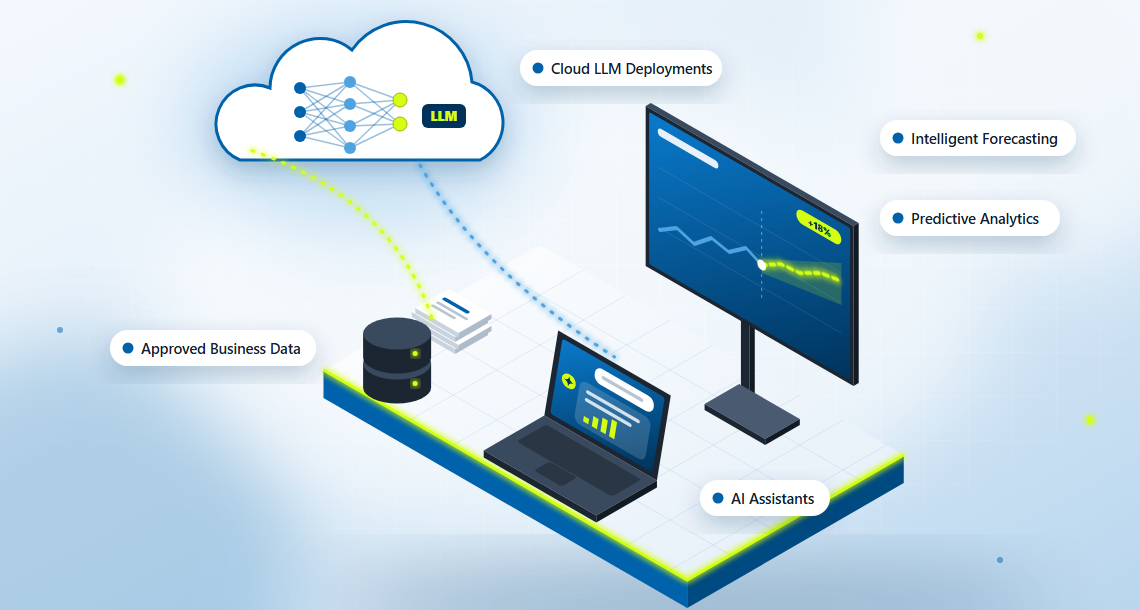
Connect Business Knowledge with Predictive Insights
Cloud LLM solutions enable applications to use large language models through hosted services or cloud infrastructure. Depending on the deployment approach, these models can support natural-language search, document summarisation, question answering and AI-assisted workflows.
Predictive AI uses historical and current data to estimate likely future outcomes. When combined with suitable forecasting methods and reliable data, it can help teams evaluate demand, plan resources and identify patterns that deserve further investigation.
Our Cloud LLM & Predictive AI Capabilities
Dayma Infotech can help businesses explore cloud AI and predictive analytics technologies for enterprise operations, customer service, sales, supply chain and management reporting.
- Cloud LLM Deployment: Explore hosted large language model services or cloud-based deployments for conversational AI, document analysis, summarisation and knowledge assistants.
- Enterprise Knowledge Assistants: Connect AI applications to approved business documents and information sources so users can search for relevant information using natural language.
- Predictive Analytics: Analyse historical and current data to identify trends, relationships, anomalies and patterns that may support business decisions.
- Intelligent Forecasting: Develop forecasting use cases for sales demand, inventory planning, workload volumes or other measurable business outcomes, subject to data availability.
- AI-Enabled Business Insights: Use AI-assisted analysis to summarise datasets, highlight significant changes and support management reporting.
- Data Integration and Preparation: Explore methods for bringing together relevant data from compatible business applications, databases and cloud platforms.
- Model Evaluation and Monitoring: Assess predictive performance, data quality and ongoing model behaviour to help determine whether a solution remains suitable for its intended purpose.
“Cloud AI helps people work with information more naturally, while predictive analytics uses data to help businesses prepare for possible future outcomes.”
Understand Today. Anticipate Tomorrow.
Cloud LLM & Predictive AI
Build AI Solutions Around Your Business Data
A successful cloud AI or predictive analytics project starts with a clear business objective, suitable data and an appropriate deployment strategy. Not every use case requires a custom model: managed cloud services, existing analytical tools or smaller specialised models may provide a more practical starting point.
Dayma Infotech can help businesses explore opportunities such as:
- Deploying cloud-based LLM capabilities for internal knowledge access and document workflows.
- Creating AI assistants that retrieve information from approved company sources.
- Analysing sales, inventory, service or operational datasets.
- Forecasting demand and identifying potential changes in business activity.
- Supporting capacity planning and resource allocation with predictive insights.
- Connecting AI applications to compatible cloud platforms and enterprise systems.
- Evaluating model quality, access controls, data governance and ongoing monitoring needs.
Each project should consider data readiness, model suitability, integration complexity, security, privacy, operating costs and measurable success criteria.
Important: LLM outputs can contain inaccuracies, and predictive models estimate outcomes rather than guarantee them. Sensitive information should be handled under appropriate data-protection controls, and important business decisions should include suitable human review.
Frequently Asked Questions About Cloud LLM & Predictive AI
An LLM is an AI model trained to process and generate human language. It can support tasks such as summarisation, question answering, text generation and conversational interfaces.
It means making LLM capabilities available through a cloud-hosted service or deploying a model on cloud infrastructure. The right approach depends on security, performance, customisation and cost requirements.
Predictive analytics uses historical data, statistical techniques and machine-learning models to estimate future outcomes or the likelihood of particular events.
General analytics often explains what has happened or what is happening. Forecasting focuses on estimating future values or trends, such as demand, sales volumes or resource requirements.
Potentially, yes. A solution can be designed to retrieve information from approved documents and connected data sources. Access permissions, data handling, document freshness and answer verification must be considered.
The requirements depend on the use case. Historical records, consistent definitions, relevant input variables and reliable outcome data can all affect model quality. Data readiness should be assessed before development.
Cloud LLM & Predictive AI Solutions
Explore cloud LLM deployment, enterprise knowledge assistants, predictive analytics and intelligent forecasting.
