


Turn Machine Data into Better Production Decisions
Dayma Infotech helps businesses explore production monitoring solutions designed to provide visibility into machine status, cycle times, production output and downtime. By connecting compatible machines, sensors, PLCs and monitoring software, businesses can capture operational data and present it through dashboards and reports.
With Overall Equipment Effectiveness (OEE) monitoring, production teams can better understand equipment availability, performance and quality, identify recurring losses and make more informed decisions about production efficiency.
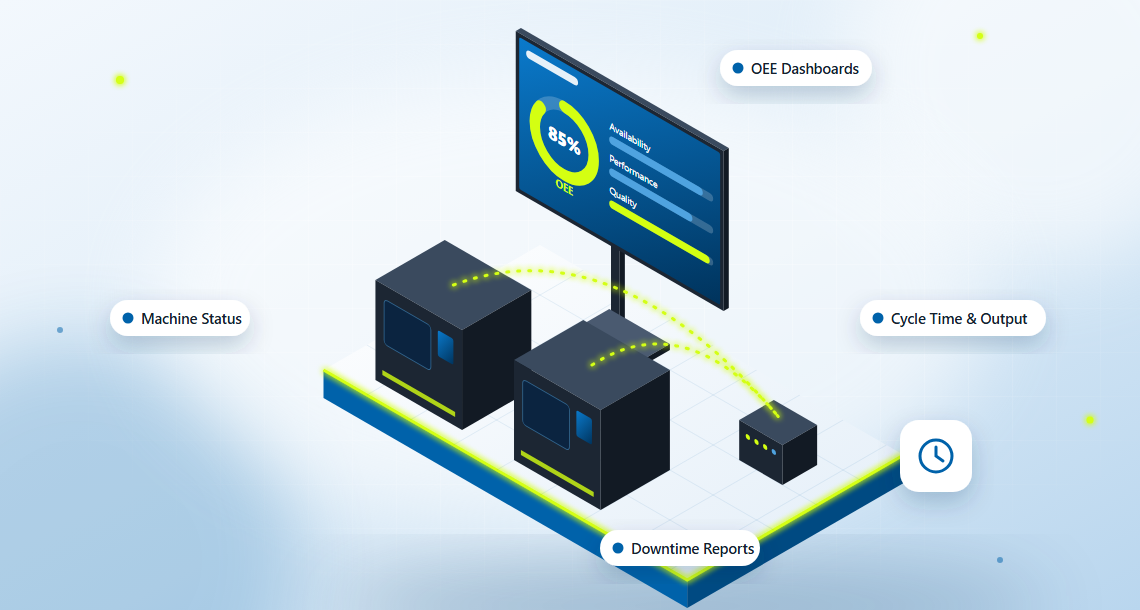
Get a Clearer View of Every Machine and Shift
Production monitoring brings machine and production information into a shared view. Instead of relying only on manual updates or end-of-shift reports, teams can use connected data to understand whether equipment is running, idle, stopped or operating outside expected cycle times.
Configured dashboards can help supervisors review production progress, investigate downtime and compare performance across machines, lines and shifts.
Our Production Monitoring Capabilities
Dayma Infotech can help businesses explore machine monitoring and OEE solutions for manufacturing plants, assembly lines and production environments.
- Real-Time Machine Status: Monitor machine states such as running, idle, stopped, faulted or awaiting material, depending on available signals and configuration.
- Cycle-Time Monitoring: Capture and compare actual cycle times against defined production targets.
- OEE Calculation: Measure Overall Equipment Effectiveness using availability, performance and quality data.
- Downtime Tracking: Record stoppages, their duration and assigned reasons where the system supports event capture and categorisation.
- Shift-Wise Production Reports: Review output, downtime, cycle times and other configured metrics across shifts.
- Production Dashboards: Present machine and line performance through visual dashboards for operators, supervisors and management.
- Performance Trend Analysis: Review historical production data to identify recurring interruptions, performance gaps and improvement opportunities.
“When machine performance, downtime and production output are visible, teams can identify losses and focus improvement efforts where they matter most.”
What Gets Measured Can Be Improved
Production Monitoring (OEE)
Understand OEE and Improve Production Visibility
Overall Equipment Effectiveness (OEE) is a widely used metric for understanding how effectively equipment is being utilised during planned production time. It combines three factors:
- Availability: The proportion of planned production time during which equipment is available to operate.
- Performance: How actual production speed compares with the expected or ideal production rate.
- Quality: The proportion of total output that meets the required quality criteria.
OEE is commonly calculated as:
OEE = Availability × Performance × Quality
For example, if availability is 90%, performance is 95% and quality is 98%, the resulting OEE is approximately 83.8%.
Dayma Infotech can help businesses explore monitoring solutions that support:
- Connecting compatible machines and PLCs to data collection systems.
- Tracking machine states and cycle times.
- Recording production output and quality counts.
- Categorising planned and unplanned downtime.
- Comparing machine, line and shift performance.
- Presenting OEE and production trends through dashboards.
- Supporting data-driven continuous improvement initiatives.
Reliable OEE reporting depends on accurate machine signals, clearly defined production schedules, consistent downtime classifications and trustworthy production and quality data.
Frequently Asked Questions About Production Monitoring (OEE)
Production monitoring collects and displays information about machine status, production output, cycle times and downtime to help teams understand manufacturing performance.
OEE stands for Overall Equipment Effectiveness. It combines availability, performance and quality into a single measure of how effectively equipment is being used during planned production time.
Yes. When connected to compatible PLCs, sensors or machine interfaces, a monitoring system can display machine status in near real time. The update speed depends on the system architecture and connectivity.
Yes. OEE can be calculated automatically when the system has the necessary information about operating time, production counts, ideal cycle times and good versus rejected output.
Many production monitoring platforms support reports by machine, production line, shift and time period. The available reporting options depend on the selected software and data configuration.
In many cases, yes. Existing machines may be connected through PLCs, sensors, industrial communication protocols or other compatible interfaces. A technical assessment is needed to confirm the available data and integration approach.
Production Monitoring (OEE)
Explore machine-status monitoring, cycle-time analysis, OEE dashboards, downtime tracking and shift-wise reporting.
